

Artificial Intelligence (AI) is constantly evolving technology, and every day it discovers new possibilities for itself. With the efficiencies that conversational chatbots and AI-powered computer programs offer, advancements are expected in cybersecurity, healthcare progression and scientific discovery. However, does the long-term environmental, psychological and sociological impact play a role in the benefits of this technology?
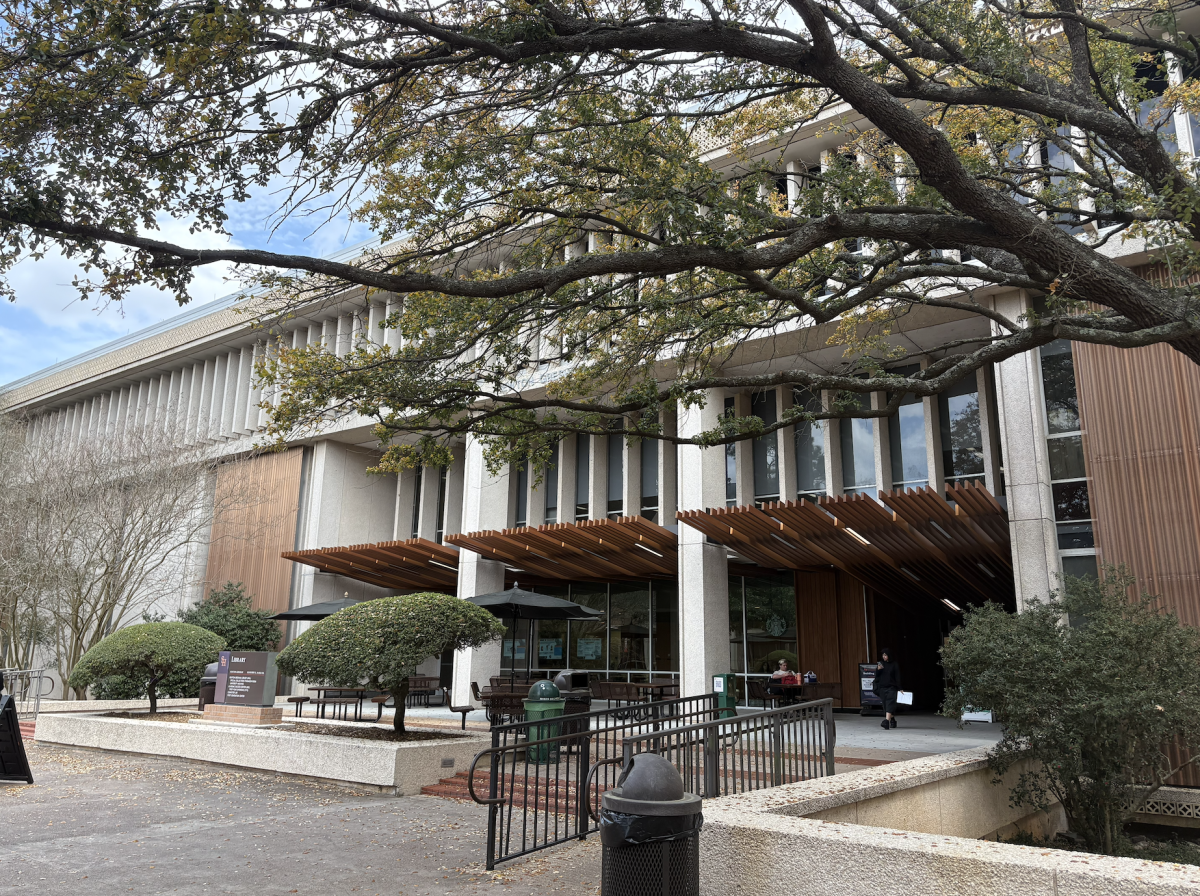
Librarians at Sam Houston State University have been testing and navigating these generative programs since their rise, expressing concerns and questions over its ability to dictate the actions of an everyday internet user.
Accuracy and cognitive Impact
Stacy H. Johnson is a research librarian at SHSU. With her bachelors of science in anthropology, early-life experiences on various journalism publications, and eventually traveling south for her librarian position, she is educated in a variety of fields.
Johnson recalls that multiple librarians at SHSU tested generative AI software, early into its rise in 2022. She states librarians Hannah Menendez, Diana Kim, Erin Owens and herself met in order “to do something about this.”
“This was back with ChatGPT 3, we weren’t even at 3.5 yet, and now I think we’re on five. We gave it a basic essay you would write for your English 1301, where you would do an opposition paper,” Johnson said. “It spit out essays that were decent, but what we noticed [is] when we asked it ‘we need you to give us scholarly sources,’ it would make them up.”
She explains the concern this prompts for her, and the measures she takes to ensure students are “aware of the pitfalls” that come with using generative AI academically.
“We had the students take the essays and basically critique them,” Johnson said. “Because, ultimately, what we were trying to do is get students to understand that you have more creativity and more knowledge and experience and connection in your pinky finger than AI has now, and probably will ever have, because a computer will never have unique human experiences.”
Johnson delves into the root of AI reliance, which she believes is the fear of writing. Before becoming a librarian, she worked as a military reporter and editor for seven years, arriving at scenes to interview those involved in an incident. When first hearing about ChatGPT, she recalled her time as a journalist.
“I would go to a scene, like plane crashes and a lot of those, and I’d be sitting there [writing]. Oh my gosh, lawyers, doctors, CPAs, fighter jet pilots who had been in war zones, would look at me and go, ‘Are you sure you want to write all that down?… Can you do that?,” Johnson said. “They would get afraid about writing. So, when I first started hearing about ChatGPT, my first thought was back to that; back to folks who feel afraid of writing.”
Rebecca Yantis, another research librarian at SHSU, specializes in Arts & Media and has an academic background in English. She shares similar concerns over the cognitive functions of those using generative AI regularly, one matter being the use of AI in creative works.
“When they were talking about how people were trying to write novels using ChatGPT, and the problem was that it was pulling from fan fiction … that did not surprise me,” Yantis said. “For one, that’s stealing someone else’s work. But on the other hand, it’s like, you couldn’t sit down and write your own story? Even if it’s bad, you can still sit down and write it yourself.”
She notes similarities in other fields besides the arts, specifically when checking mathematics and coding. She mentions the issues coders face when attempting to utilize the technology.
“Actual coders have gone on there and, because they’ve tested it, they’ll go in there and be like, ‘It’s gibberish. It looks correct, but it’s complete gibberish,’” Yantis said.
Environmental impact
Johnson also noted the “environmental costs” that have spurred from the increase in AI software development.
“It’s like, you can make a funny video on Sora, but … you need to consider every single time you ask this to do something, it’s using water. It’s using resources,” Johnson said. “The government’s trying to have efficiencies, and we understand that, but still.
Noman Bashir, a fellow with the MIT Climate and Sustainability Consortium and a postdoc at CSAIL, explains the process in which AI data centers utilize resources. Chilled water is used to cool a data center by absorbing heat from computing equipment, estimated that for each kilowatt hour of energy a data center takes, it would need two liters of water for cooling the machinery. This need for water, alongside the growing number of data centers being constructed and maintained across the nation, can strain local water supplies and disrupt nearby ecosystems of areas neighboring them.
Yantis believes that environmental risks will not threaten users to slow down, and that we must navigate finding ways to utilize the technology ethically despite this.
“Generative AI is a horror show when it comes to natural resources and water… taking over neighborhoods and stuff like that,” Yantis said. “But it’s one of those things where they’re going to use it anyway. How can we create an ethical framework for this?”
Benefits
Despite the downsides, Johnson and Yantis recognize that there are possible benefits to the advancement of technology like this. One positive that Johnson points out is assistance in breaking language barriers, explaining that constant conversation with AI chatbots has proven beneficial to some.
“I can see a lot of benefits, especially maybe for a student who English is their second language. There’s been studies showing that ChatGPT has been helping them with their English, which I think is great,” Johnson said. “It’s wonderful because it removes a barrier. If somebody’s English isn’t quite up to par or whatever you want to say, that helps them.”
Johnson also acknowledges the possible breakthroughs that AI technology could provide in healthcare, advancing scientific research.
“I feel very hopeful that we will get some nice health benefits out of this, because it can analyze CT scans. It can do that kind of stuff on a scale we need for that kind of research,” Johnson said. “But again, even then, you have to check it; you have to be in the driver’s seat and make sure you don’t let it just take over.”
Advice to SHSU professors
These SHSU librarians, amongst others, have made efforts to provide students with resources to combat and/or adapt to the growth of AI technology. As the threat of AI use in schoolwork rises, professors find themselves researching new ways to combat it. Yantis provided advice on how professors at SHSU can ensure they “cover their bases.”
“They need to specify in their syllabus ,‘Hey, you are allowed to use ChatGPT for this, this, and this and nothing else,’ because again, it is one of those things where you just need to put some guidelines down,” Yantis said. “Then when someone decides to write their entire paper with ChatGPT, you could point at those guidelines and say ‘I said you could use this for this, this, and this. I did not say that you could write your entire paper.’”
Johnson says that students use AI only when they lack confidence in their skills. She states that a good relationship between a student and a professor can make a difference in their reliance on AI tools, rather than punishment for usage.
“You want the relationship there to where you can support the student before they ever take the step when they think in their head ‘ChatGPT can do this better than me’ because I guarantee you it cannot,” Johnson said. “My advice is to get close to your students and find out what it is they’re struggling with that makes them feel the need to use this.”
Looking ahead
According to the librarians, the way these generative models are being used to produce content and ‘assist’ in research or writing is inevitable. Johnson states we “have to invite AI to the table,” and the only way to navigate a world with constantly advancing AI technology is to approach the topic with a wary view.
“If you consider ‘I know what this is doing environmentally, I know what it’s doing,’ and you judiciously choose based on your understanding, then yeah, there are ways [to use it],” Johnson said. “I do feel like it can be used in a way that is going to lessen harm, but we’re going to have to, as a human race, agree that this thing has problems that are worse than the benefit.”
When weighing the positives and negatives of AI, both generative and non-generative, Yantis also believes there’s more harm than benefit, primarily due to the major lack of limitation. She refers to the recent incident with social media platform X, in which the app faced major backlash over AI chatbot Grok’s ability to create pornographic imagery from photos that users post.
“I think it’s more cons than pros, at least at this point, because there haven’t been any limitations placed on it,” Yantis said. “I think that AI needs to have limitations, because think about the Grok AI and the child porn issues. There needs to be something there, and they didn’t even bother to limit it, they just put it behind a paywall.”
Johnson says her cynicality is “because it’s already kind of been integrated in so much.” She shares that any future AI restrictions are highly unlikely, and only human awareness can limit harmful AI activity.
“I open my email on Outlook, and there’s Copilot. These systems are already kind of baked in, so I don’t think that we’ll be able to get away,” Johnson said. “I think as long as people keep their awareness, they keep thinking ‘this thing’s going to lie to me, I can’t trust it,’ then that maybe will help. But it definitely is on us as a campus to agree and decide, how are we going to do this? How are we going to use this?”
Yantis’ perspective on future limitations differs, stating that AI usage restrictions are possible, as long as the companies who own the data centers invest in them.
“I think they can be put into place. I think a lot of people just don’t want to bother, because it would take time and energy and money,” Yantis said. “But it is a machine, that’s the thing; It’s been built. So, unless an AI grows sentient or decides to go rogue, which is highly unlikely, I think we can put strictures in place. It’s just a matter of getting them to do it.”


