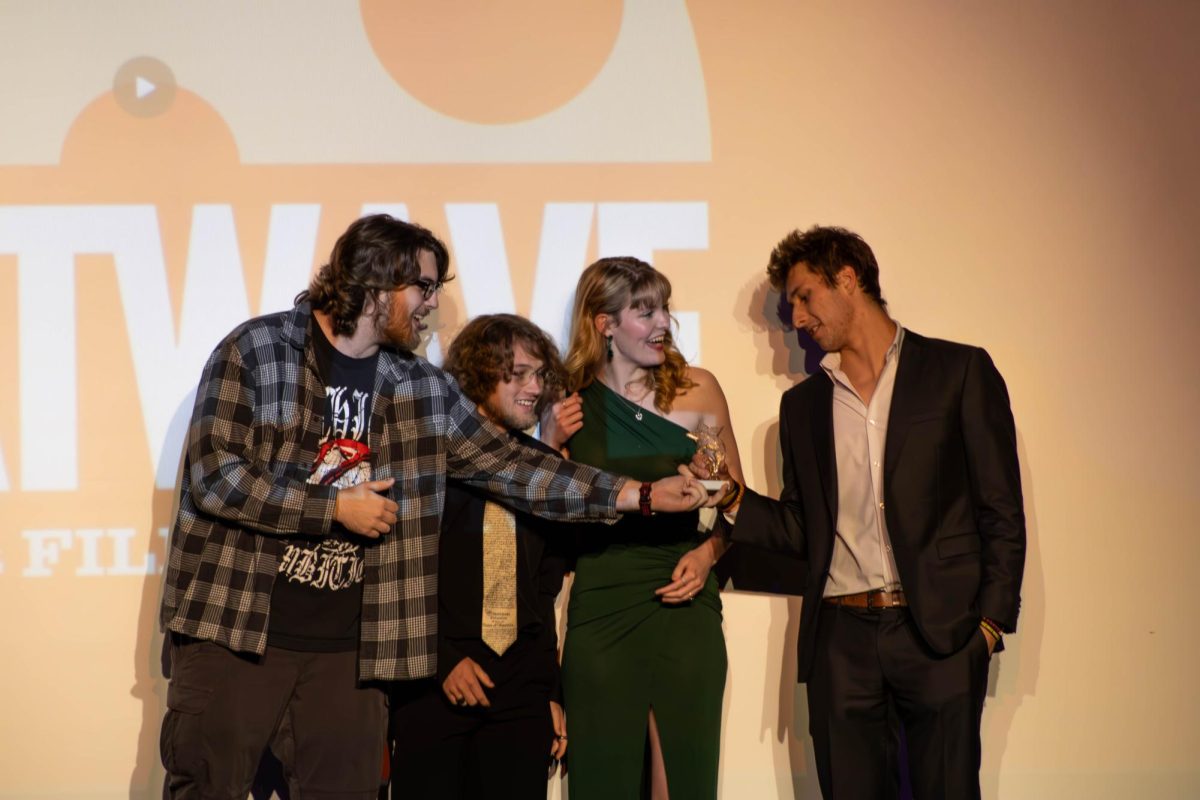


College of Arts and Media Dean Dr. Jason Vest shared his initial approach, perspective and philosophies behind the decision on SHSU’s upcoming production of “Angels in America.”
Jay Neupane: So, you’ve stated before that you have a background in vocal music performance and even high school theatre experience; can you tell us a little bit about your connection to theatre?
Dean Jason Vest: I have always loved to be on stage. Always, since I can remember. Well, my first love has been music; I have a doctorate in Vocal Performance. So, I’ve studied the music and the technical performance of it because I have to, as a professional, but what I really love is the stage.
One of my mentors, Craig Hella Johnson, talks about how “a performance without an audience isn’t a performance.” The audience is part of every performance. And that’s what I love most, is even if I’m doing the same show or a script over and over again, every performance is different because the audience is different, and the way you connect with them is different.
Jonah Bilanoski: With “Angels in America,” how did we come about picking this show? To our understanding, there was a different show we were doing before switching to this one. Can we know a little about that decision?
Vest: So, originally, the faculty had chosen “The Inheritance,” and I believe it was with input from the students; I think that was what the students really wanted to do. We talked about it at length, over many months, and I was trying to be really sensitive about our audiences here in Huntsville, Texas, and our audiences in Texas in general, and kind of the mood of the country.
That same mentor who I talked about, what he’s really great at, and why I love him so much, is he’s able to bring people different perspectives without punching you in the face. I think there was a fear that “The Inheritance,” because of the explicit nature of the content, would be like a punch in the face to people. And so, we want to open people’s minds and perspectives, and we aren’t going to do that if we offend them. I think there was a little bit of fear that that particular play would offend a lot of people. I think Angels was a way to bring some of the same perspectives to the public without pushing them away, if that makes sense.
Neupane: What are some pros to “Angels in America” that “The Inheritance” did not have?
Vest: I will just say, to be fair, I read the script for “The Inheritance,” but I haven’t seen it, whereas I know Angels better. So, I can say that from my perspective, Angels presents a sort of multifaceted story that I think people can connect to in different ways. There are issues of sexuality and identity, but also of religion and freedom and conservatism versus more progressive ways of thinking. There are a lot of ways to connect to this story.
And I also think people just know it better, because of its history, because of the HBO series. I think there’s more opportunity to bring in an audience to this.
Neupane: What do you think is the importance of bringing it to that audience?
Vest: Honestly, I’m curious to see how it will be received… Obviously, I think times have changed since we’ve done it here and times have definitely changed since the play was first written. And the subject matter- we’re talking about the ‘80s when things were very different in the world. I grew up in the AIDS epidemic in the ‘80s and I remember very well how different the dialogue in the world was at the time. And so, I’m interested to see how people will receive it as a work. Because in some ways, it is dated, to be honest, but also relevant.
Bilanoski: I know you’ve stated before you wanted the arts and media program here to sort of be a cultural leader or epicenter, from here to Conroe and around. Do you think “Angels in America” is a good stepping stone to lead and take charge in that sphere?
Vest: Yeah, art can play many roles; we can entertain, we can bring beauty into the world, we can also shock, we can bring people to new ways of thinking, and I think the kinds of work we do all play into that. So, I think Angels plays into that mission of being the anchor for arts and media education in this area, in the same way that us doing, let’s say, “South Pacific” would be. A much more traditional play, but that has themes about identity and racism. Again, helping people understand that the differences between us are so minuscule and what’s important is love, and how we’re treating each other and the kind of society that we want. I think Angels speaks to that just as much as “South Pacific” does. I think they both achieve that mission.
Related: Dean Vest outlines vision for College of Arts and Media
Bilanoski: Another question I had about Angels was actually some of the challenges of such a long show; I personally was curious about how that sort of impacted the way the season was done here.
Vest: Having such a long show, and such a complicated show at that, is a challenge for our production team specifically. Now, we took a seven-hour show that had been originally planned and replaced it with another seven-hour show, so in that way, we were kind of prepared for that. But there are specific challenges of this show, like an angel flying, that we had to work out with the director and our technical team.
When you have a longer show, there are lots of considerations. Like, if we’re putting all this work by the actors and production team to put this up, do we do a longer run of it than you would with an hour-and-a-half-long show? So yeah, we talked about those kind of things, it’s just a logistical challenge. Like, how do you structure the performance? Do you do seven hours in one day with a break in-between? Do you break it up and hope people come? Because they can’t just come to part two and miss part one. How do you figure out how you’re going to structure that with an audience?
Neupane: Is there anything else you wanted to add that you wanted to mention about “Angels in America”?
Vest: Personally, my background, I’m a member of the Church of Jesus Christ of Latter-day Saints, which has a prominent role in [“Angels in America”]. And the other side of my family is Jewish, so this play touches on two religious traditions that affect my family. I appreciated that the author of the play talked about how this isn’t meant to be a commentary on religion, nor is it meant to be factual that “all people in a religion are this way,” but it is more a framework for the play and for certain points of view. And I did get a chance to talk with the cast and the dramaturg about, “What are the aspects of the religion, especially in the way that it was practiced in the ‘80s, that led to the characters making the decisions that they did?” And I do think it’s relevant, but also, I would say to people not to take what’s done and said in the play as a commentary on any religion.
Neupane: Are there specific aspects of the Mormon and Jewish representation in the play, and even in the HBO show, that stick out to you?
Vest: Well, I think there are only two factual, real-world characters in the show. Roy Cohn is one of them, and he’s portrayed in the play as LDS, as Mormon, but he was actually Jewish. He worked under Joseph McCarthy and worked to root out “communists,” “liberals,” while being a closeted Jewish man. He was known for being very volatile- he is in the play. So it’s interesting to think about that. I would say that I think you can watch the play and think that the Mormons in the play, the LDS, are repressed, super-conservative and inhibited by their religion, and therefore have to break out of it to fully embrace their identity, or to be free. I would say that’s not been my experience with the LDS church, but I know that people can have that experience.
Neupane: What would you tell someone interested but unsure about seeing this play?
Vest: I would say give it a try, first of all. I’ve seen plays or shows or even musical works that I didn’t think would interest me at all. Even if I haven’t loved them, I’ve appreciated something about them, and I think there’s no way you won’t appreciate something about this. I mean, even just the way that the production is being done will interest people.
I would also say to understand the background of the play. Understanding, again, the ‘80s AIDS epidemic and the feeling of the ‘80s and ‘90s around homosexuality and gender and politics and this family-values era, and that “Angels in America” was meant to confront many of those ideas. So, understanding that helps you put it into context a little bit.
Sam Houston State University’s production of “Angels in America, Part One: Millennium Approaches” will open at 7:30 pm on Wednesday at the University Theatre Center, with “Angels in America, Part Two: Perestroika” scheduled for Thursday at 7:30 p.m.