
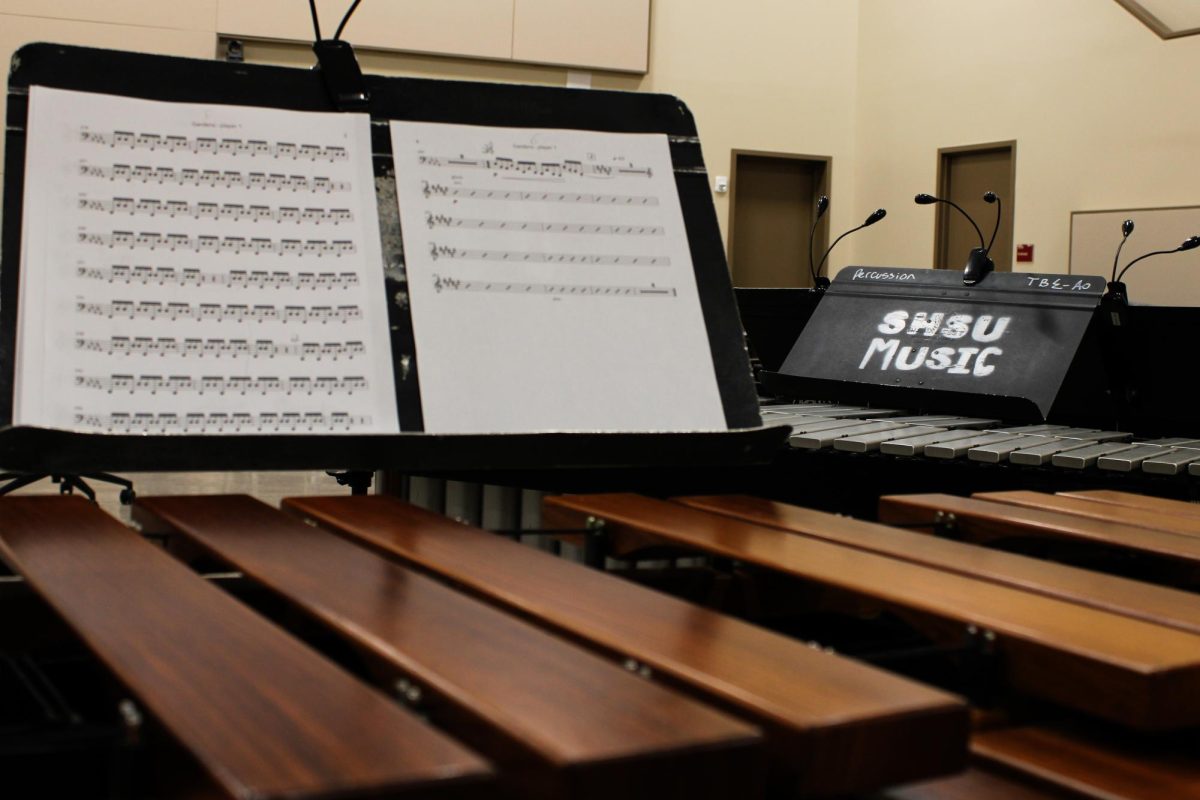
Sam Houston State University’s percussion ensemble is set to perform a unique program titled “(un)Natural” on March 19 in the Gaertner Performing Arts Center.
“(un)Natural” integrates multimedia elements such as video technology to depict themes of nature; the natural environment in the world and the digital nature of humanity. The comparison between the two spectrums largely represents the idea that what is considered “natural” is based on each perspective.
“Humans occupy an interesting middle ground because we can exist in multiple environments and have such an impact on them, whether it is the digital spaces we ‘occupy,’ the cities we live in, or how we treat the natural world with regards to pollution, preservation/conservation, etc.,” said Lecturer of Music (Percussion), Dr. Boyce Jeffries.
The idea for the program came about after a recital Jeffries gave last September, in which he used a multitude of multimedia. This ensemble, however, has a couple of new physical additions added for a more immersive audience experience.
For instance, in one of the pieces, three musicians will have conch shells filled with water that are spun to create a gurgling sound as water comes out of them. This inspiration comes from the piece’s composer, John Cage, and his idea that sound can be contextualized as music.
“Percussion music lends well to that because our art form is built on experimentation, different timbres, and different materials and techniques to make sound,” said Jeffries.
To ensure each performance in the program runs smoothly, certain collaborative efforts between Jeffries, the ensemble and other production management were crucial.
Although Jeffries did most of the heavy editing, he taught his students how to create click tracks with Audacity (an open-source music software for recording and editing), which are important in keeping the musicians synchronized with the multimedia throughout the concert.
A click track is an audio metronome typically played through headphones for musicians.
“That’s, I think, been the most rewarding challenge for them,” said Jeffries. “Learning how to use the technology and realizing that if you’re going to do these things where they’re synchronized and it’s a very production-heavy concert, there’s so much more work that goes into it than just practicing the notes and the rhythms they have to learn.”
Jeffries expressed his interest in broadening the utilization of multimedia with physical forms of art moving forward.
“I’m hoping that this project will lead to more collaboration within the College of Arts and Media,” said Jeffries. “If there’s any students in, you know, journalism or mass comms or people that want to do film studies and they want to collaborate with me in the future, I’m game for it.”